↑ Chapter One Contents · All Chapters
The Romig name replaced an older, unnamed farmstead designation in Ittlingen during the post-1648 resettlement decades. A citizens' list from 1695 contains no Romig — the family had not yet arrived, or had not yet reached the status of documented citizens. By 1718, a civic document names "Hanß Adam Romich" among the recorded residents of the town.14
The farmstead the Romig family held stood in the Unterdorf — the lower village — with a house, a courtyard (Hofreite), and approximately 69 Morgen of agricultural land spread across three rotation fields: the Berwangen fields, the Steinsberg fields, and the Eppingen fields, plus meadows. In the feudal structure of Ittlingen, the Romigshof was one of six closed, integrated farmstead estates (geschlossene Hofgüter) in the portion of the village administered by the Gemmingen-Hornberg lordship. The other five were the Mayleshof, the Bernhardshof, the Fleckenhof, the Hahnenhof, and the Schottenhof. All six owed 12 days of span-service annually to the lords — two horses or oxen for a working week of field work — an obligation described in the 1839 service-redemption agreement as held "since time immemorial."15
The Bernhardshof — the farmstead of Agnes Margaretha's family — stood in the same feudal district, under the same Gemmingen-Hornberg lordship, side by side with the Romigshof in the civic record. Both families paid obligations to the same overlords. When John Adam Romich married Agnes Margaretha Bernhard around 1712, he was joining two families who had been bound to the same land and the same lords since the resettlement generation.
By 1834, the Romigshof had 22 shareholders — a farm divided and subdivided through four generations of inheritance after the emigrating branch sailed in 1732, leaving collateral descendants to hold what remained.
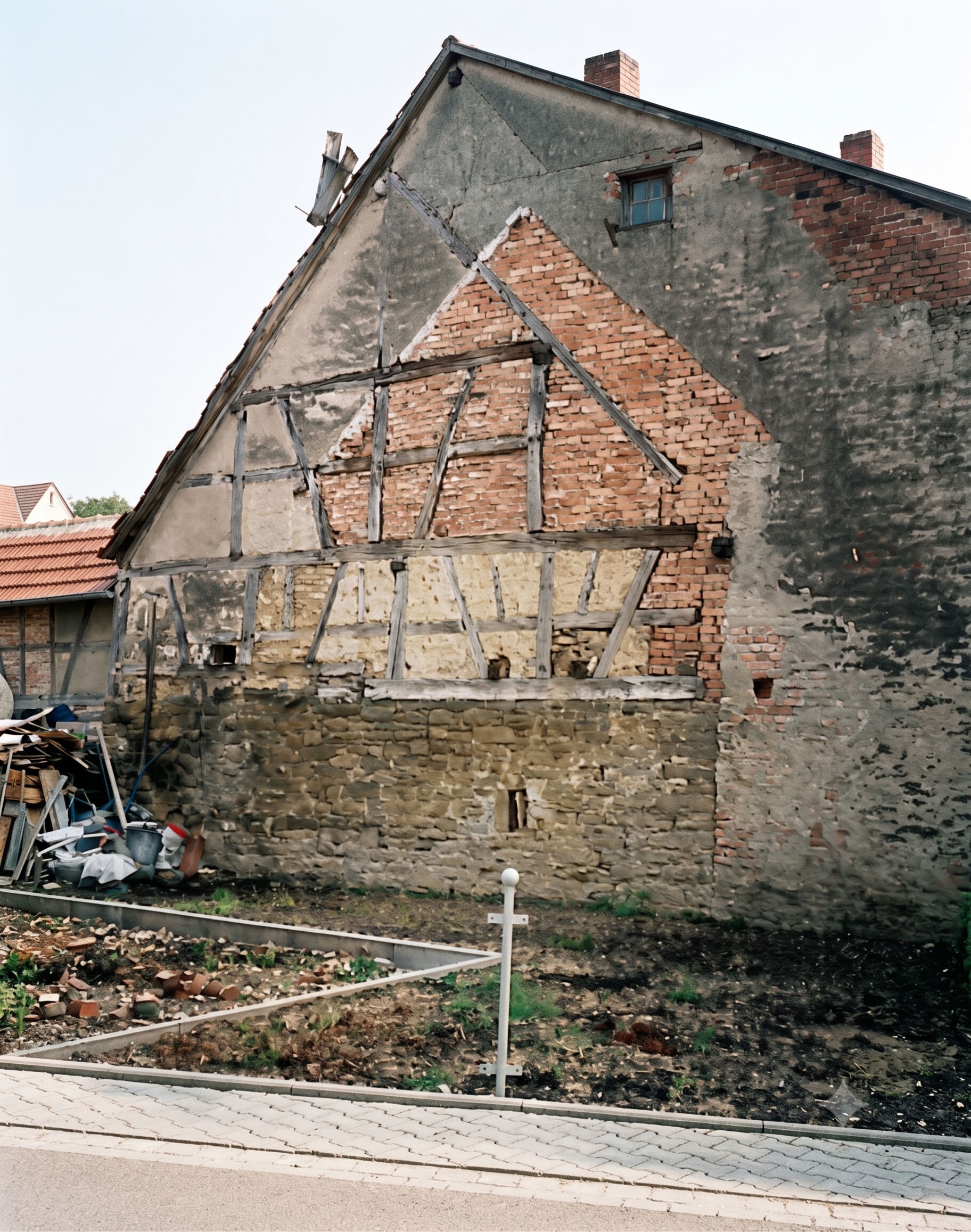
Barn addition to the back of the Romig house, Ittlingen, Germany. Photograph by Joan Reed.