About 40 miles east of Ittlingen, in a narrow valley in what is now the Hohenlohekreis district of Baden-Württemberg, lies a village called Crispenhofen. Tax records from 1554 list five households there with the name Romig — written in archaic 16th-century German script, in an archive that did not expect foreign visitors.
Those records are housed in Neuenstein Castle, a Renaissance-era fortress with a moat and a drawbridge, built in the 1400s and expanded after 1565. The castle now holds the Zentralarchiv des Hauses Hohenlohe. In the summer of 1997, retired military officer Clarence Romig — a descendant of John Adam's grandson Jacob — drove there with his wife Ruth and other family members after 30 days of research travel in Germany. A genealogist he had hired before the trip had reported, just before departure, that the Romig family may have come to Ittlingen from Crispenhofen.
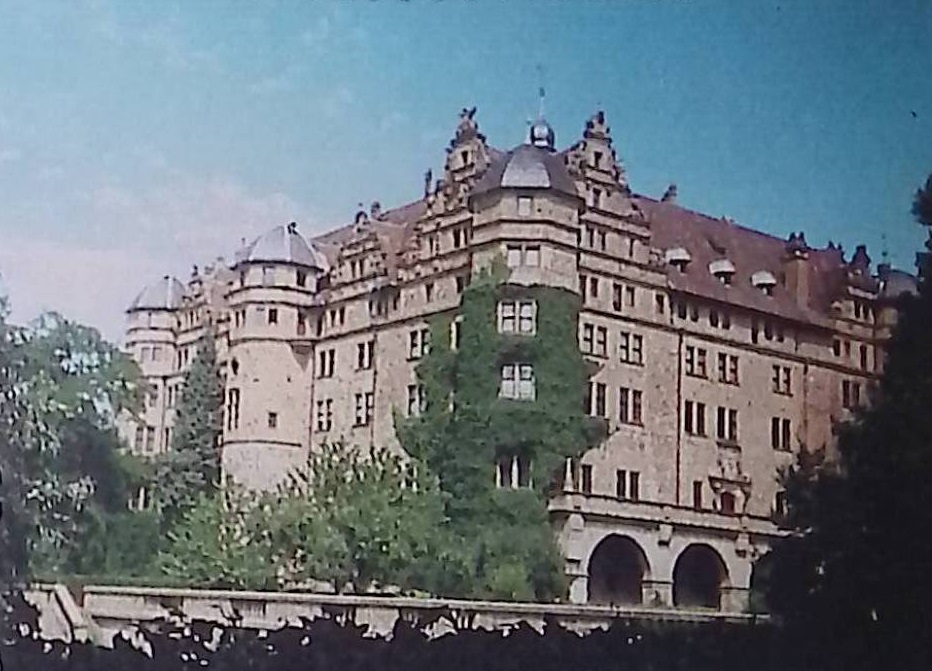
Neuenstein Castle in Crispenhofen houses the regional archives. Photograph by Joan Reed.
"Cramped into a valley so small that the village could never really grow," Clarence wrote to his distant cousin and fellow researcher Evelyn Romig Kearns that December.3 The village had a town hall no longer used for town business, a few dozen houses, a population of about 500. "Only a few cars parked next to the buildings suggested we were not there a couple hundred years ago."
The archivist brought out the 1554 contribution ledger for the Ingelfingen district. The old documents recorded heads of households and their tax obligations in Batzen — a common silver coin of the era. Among the names in the Crispenhofen entries, the archivist confirmed five Romig households in the list. The family obtained photocopies.
Clarence Romig was scrupulous about what this established and what it did not. "There is no direct link that we can claim Romigs of the two towns are of the same lineage," he wrote.4 The name was common in this corner of Germany. But the 1554 records confirm that the name had deep roots in the Crispenhofen area — that whoever John Adam Romich's father was, he came from a region where Romigs had been farming, paying taxes, and building families for at least two centuries before any branch of the family sailed for Pennsylvania.
Three Branches
By the mid-17th century, parish registers from Crispenhofen's Evangelical church give a clearer picture. At least three distinct Romig family heads lived in the village simultaneously. An elder Wendel Romig — born perhaps between 1615 and 1625 — was the patriarch: a permanent resident with wife Margaretha, already serving as godfather at Michael Romig's household christening in February 1658.
Michael Romig was almost certainly Wendel's son. By March 1663 the church register records Michael as a Gerichtsmitglied — a member of the village court — at the baptism of a child named Eva Catharina.5 Court membership was a mark of civic standing. Michael Romig was not a laborer at the margin of village life; he was a man trusted by his neighbors with their civic affairs.
A second son of elder Wendel — Stoffel, also written Christopher — also headed a household in Crispenhofen. His wife was Susanna, and their children are documented from the baptism registers: Margaretha (born 1652), Johannes (born 1655), Hanss Christiophel (born 1656), and Wendel, born March 18, 1659. By 1663, a daughter named Anna Maria was baptized at a place called Bobachshof bei Ingelfingen — the family had begun to move east.6
A third Romig, Andreas, had also lived in Crispenhofen, though he died before 1688. His daughter Maria Barbara married a man from the village in May 1688.7
And then there was the wheelwright.
In September 1681, Joerg Wendel Romig — Michael's son, the patriarch's grandson — married Barbara, the daughter of Martin Jenders of Crispenhofen.8 The marriage register identifies the groom as a Wagner: a wheelwright, a maker of wagon wheels and carts. A cartwright in a Württemberg village was a man of useful, practical skill; villages depended on him to keep the wheels of commerce and agriculture turning.
The name Wendel runs through this family like a thread. The patriarch was Wendel. He gave the name to a grandson through Michael’s line — Joerg Wendel, the wheelwright — and Stoffel’s son was also named Wendel. One of those threads can be cut here: the wheelwright married Barbara, daughter of Martin Jenders, not Margaretha. That distinction matters more than it looks. John Adam’s own account of his parentage, transcribed generations later by Hollenbach, names his father as Georg Wendel Romich and his mother as Margaretha.9 Given names drift with a clerk’s spelling — Georg, Joerg, and Wendel shift easily from one register to the next — but a wife’s name does not become another woman’s. Whoever Georg Wendel Romich was, he was not the wheelwright. He may have been Stoffel’s son, unmarried on any surviving record; he may have belonged to a household this chapter never reached. The town had Wendels to spare. It did not leave enough of them a paper trail to say which one was John Adam’s father — whoever he was, he stayed in Germany. It was John Adam who crossed the ocean.