↑ Chapter One Contents · All Chapters
In 1732, John Adam Romich was 43 years old. He was a Hofbauer who had sealed a legal document before an Imperial court. He had a house in the Unterdorf, a civic network that extended from the Ox Inn to the mayor's house, nine children, and twenty years of built-up standing. He was not a desperate man.
He was a man who had watched the Schweinekrieg lawsuit consume eleven years and produce no enforcement that the lords acknowledged. He was a man who knew the chains on a Kraichgau farmer's life. He was also a man who had watched other Kraichgau families sail for Pennsylvania and send back letters. Chain migration was running: families from Neidenstein and the surrounding villages had been moving for a decade. Among the passengers of the Dragon that September was a man named Johannes Geiger — a surname that appears as a godparent witness in the Romig baptism records.30 The families knew each other.
What finally tipped the scale is not recorded. Pennsylvania had been promoted aggressively throughout the 1720s and 1730s as a land of cheap acreage and religious tolerance. William Penn's tolerant proprietorship offered what the Imperial Chamber Court at Wetzlar could not deliver: a civic life that did not depend on lords' goodwill.
Also aboard a ship headed for Pennsylvania, though she could not have known what the crossing would cost her, was a woman traveling under very different circumstances. Their paths had not crossed yet.
The Dragon sailed from Rotterdam under Captain Charles Hargrave, put in at Plymouth for final provisions, and crossed the Atlantic with 185 passengers. It was not a gentle crossing. Four passengers died at sea. Others were sick when the ship reached Philadelphia.
On Sept. 30, 1732, the men capable of taking oaths descended to do so. The captain's list, the oath of allegiance, and the oath of abjuration all record the same two names from Ittlingen: John Adam Romich and his eldest son Friedrich, 18.31 Both were marked healthy. Both signed.
Agnes Margaretha is not on any of the lists. Women were not required to take oaths. She had crossed with her husband and their surviving children through six or eight weeks at sea. She had made it.
She did not survive long after arrival. John Adam noted it in his memoir with the bluntness of grief: his wife had died.32 He recorded that they had lived together 20 years. Then he moved on, because a man with children in a new country had no choice but to.
Across the ocean, in Ittlingen, Philip Balthasar and Agnes Elisabetha baptized their daughter Anna Elisabetha on Dec. 31, 1732 — the last day of the year John Adam had sailed away. The primary-source baptism record carries a marginal notation beside Anna Elisabetha's name: † 1732. The child died within months of her baptism.33
One family. Two lines. One continent apart, and both in grief before the year was out.
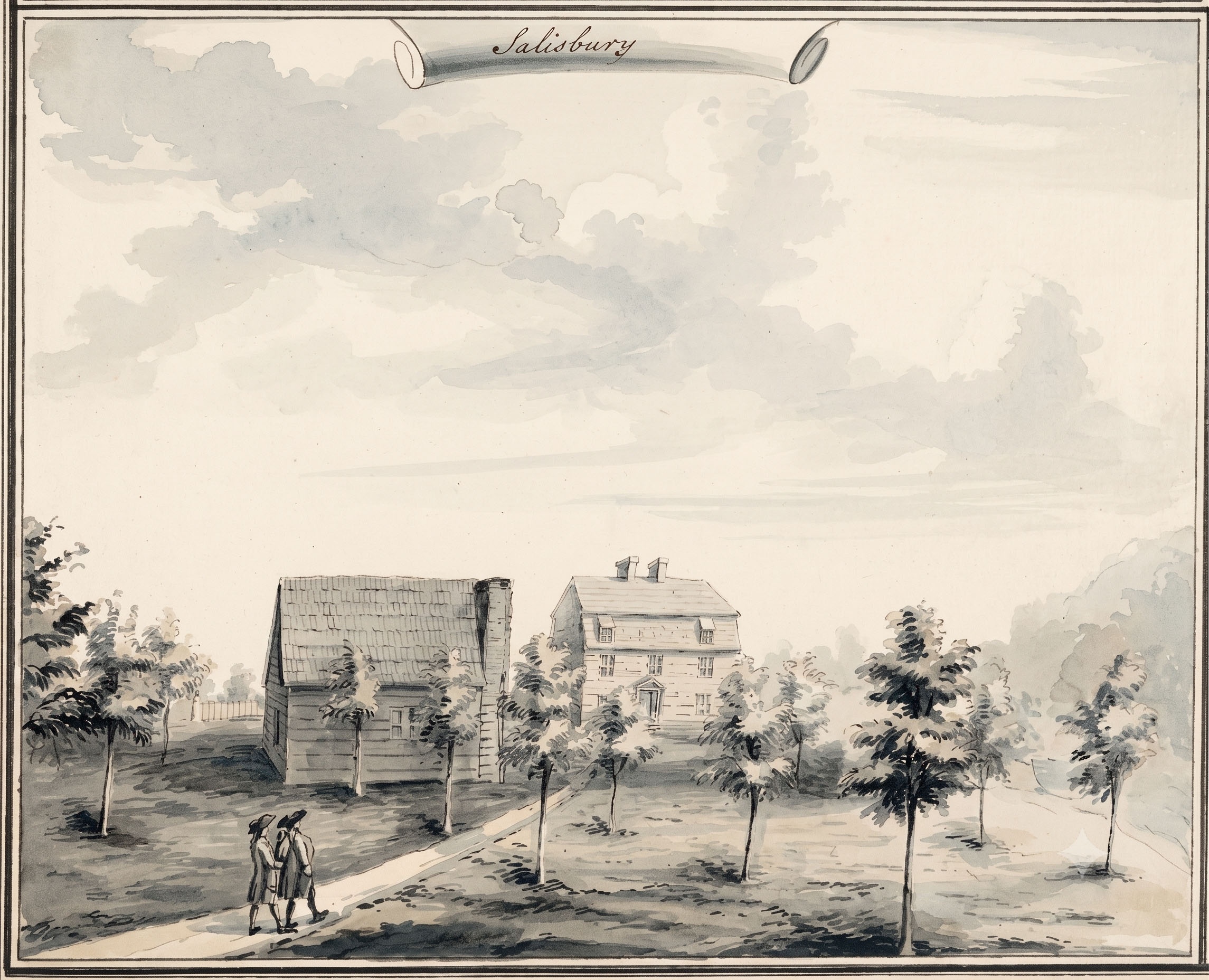
Emmaus Moravian village at Salisbury, Pennsylvania, in 1754. Courtesy of the Moravian Church Archives.