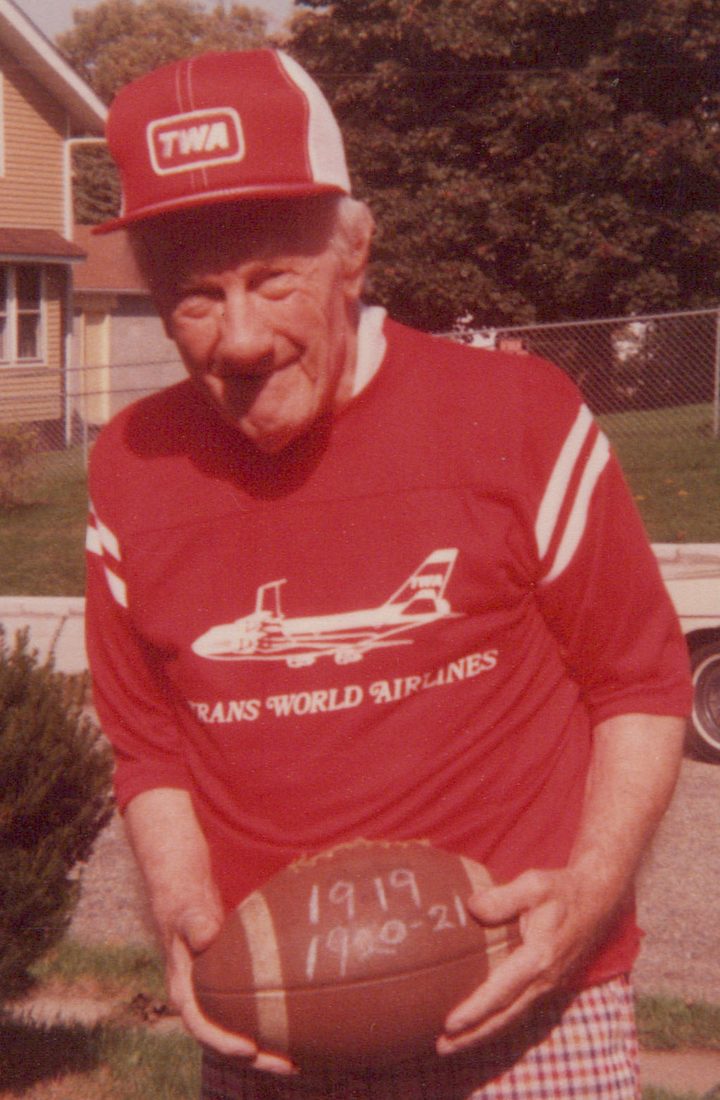
Sarah's grandson, Clifford Romig, was a teenager when she died, old enough to remember her as a living, particular woman, not as a headline in an old newspaper. Interviewed by Karla in 1989, he laughed as he described her: "You know Grandma Houser was kind of a rounder." Asked if she drank, he said no, "but I think she did drink beer. We went up to Akron when she had to go into the saloon and get a beer before she drove me home. I can remember that." The saloon, he said, was "down the cellar up on Main Street."47
Clifford Romig, grandson of "Grandma Houser," remembered her fondly. 1980s photo.
He remembered her temper on his behalf, too. Asked once about hearing President Taft speak as a boy with Sarah accompanying him, Clifford's memory wandered instead to a different afternoon: "Hey you know my dad was learning me how to drop plant potatoes. And I was planting the potatoes and he was back up the hill and she come over and give him heck for using me when I was just a little kid to plant the potatoes and Pop got mad and he never would take me to work or do anything. Grandma Houser just set into him... And she didn't like kids working."48
It was around that same conversation that he explained the little room built by his father onto his family's house on High Street, just for her: "he made a little room for Grandma Houser to live in. Mother-in-law's room. It had a window and a door and it went out on the front porch over to the side... It had a private door to that room."48
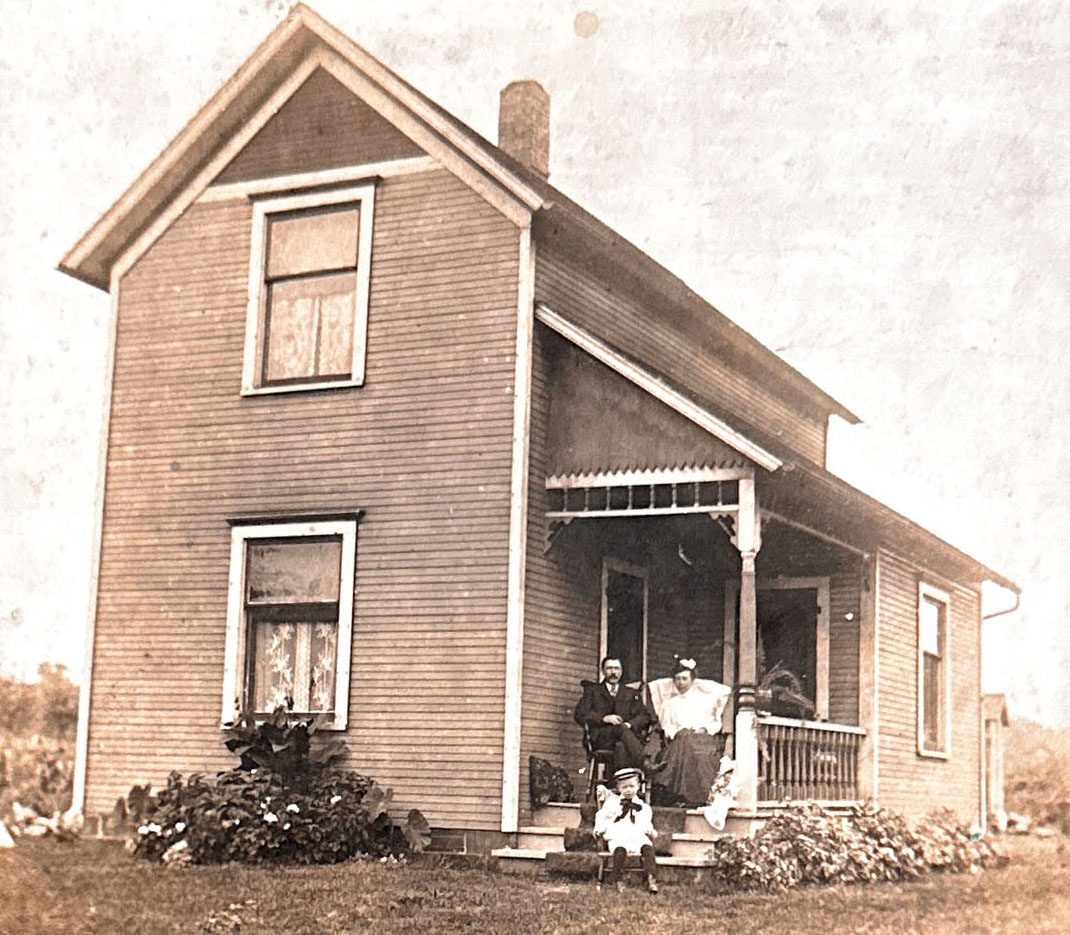
The house on High Street in Barberton. The porch entrance to the mother-in-law room at the back. Pictured are Archie, Annie, and little Clifford Romig in the sailor suit.
Of Wesley Houser, the husband Sarah had divorced, Clifford had less patience: "Wesley was a drunk. He couldn't even get home from work with his pay. He spent it all before he'd get home. Make Grandma mad."49
Yet when Wesley died, years after their divorce and her death, it was discovered that Sarah had bought a burial plot beside her own. "He's right beside of her," Clifford said. "But she's the one who got a stone."50
The stone itself carries the wrong birth year, and Clifford knew exactly why: "Mom guessed her age when she was born. It wasn't right. Mom didn't know when her mother was born. She guessed '47, 1847... They were funny people, Mom was. My mother."51
The musical thread that ran through Sarah's father's household in Devon surfaced again in her own. "She could play good," Clifford said of her accordion playing, seventy years after the fact. "I wish I had that accordion."
She had once smuggled three silver flutes into the country in a suitcase, undeclared, said Clifford.52
(In a curious coincidence, a 12 Jan 1876 Summit County Beacon article about the 20-piece band — in which Joseph Lehman had been a member — it was reported, "The Akron Junior Band… expect their new instruments in two weeks. The instruments are to be of silver and entirely new.")53
What survives of Sarah is partial and often contradictory: two newspaper accusations that were never proven, an assumed name taken up in a new city, three marriages across two countries, a mother's illness and a husband's death that still does not sit quite right, and finally an epidemic that her own death certificate never names.
What also survives, underneath all of it, is a boy who grew into an old man still glad, seventy years on, that the woman down the hall with the private door had been his grandmother.