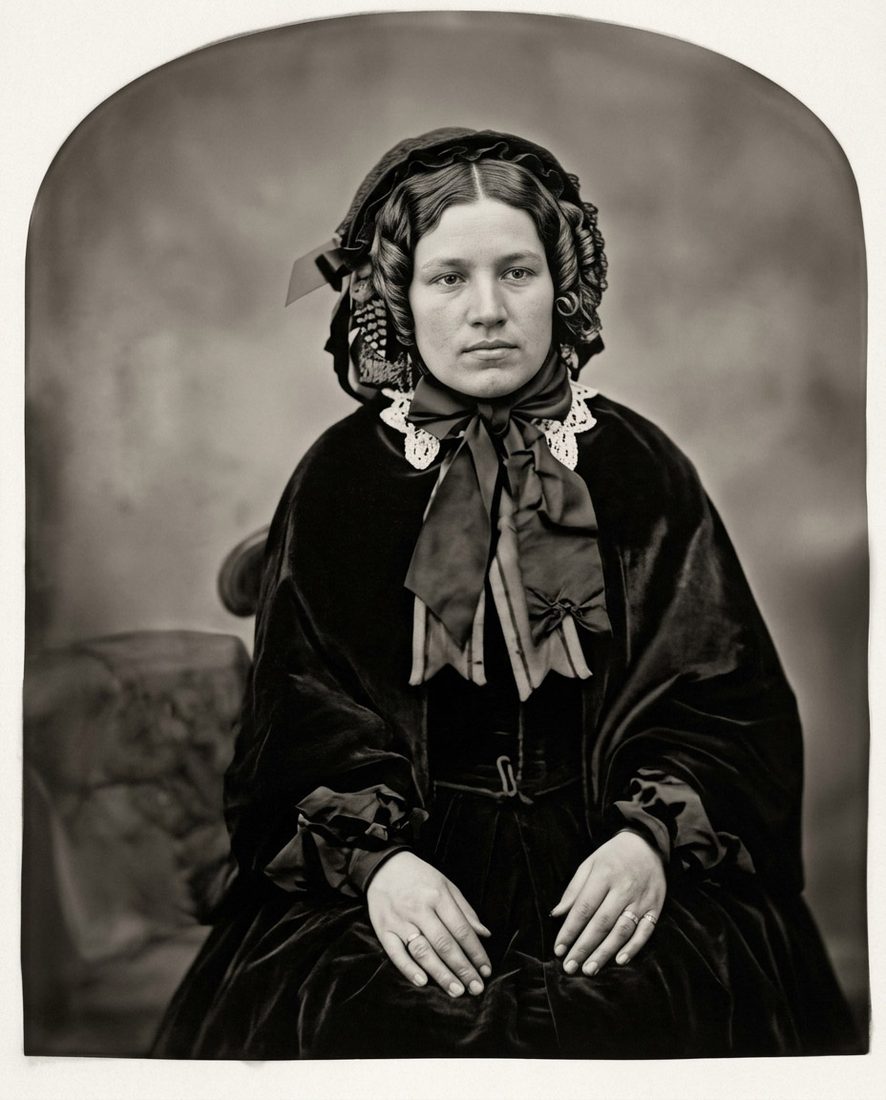
Growing up in Devon, Sarah lived in a family touched by mental illness.
Her mother, Mary Carter, was committed three times to the Devon County Lunatic Asylum at Exminster, during Sarah's childhood and adolescence years. On the first admission, 27 May 1861, when Sarah was not yet eleven, the certifying physician Robert Brent wrote that Mary was "not rational upon any one thing, either as to her own health, the condition of her family or friends," and recorded what her husband had told him: that she was in the habit, at night, of visiting persons at a distance "in a state of nudity" and "using most disgusting & incoherent language."12 She was discharged "recovered" that July.
Two years later, on 6 July 1863, Brent examined her again and found her "violent — requiring restraint for the last 2 days — perfectly unable to control herself, either in conduct or language"; the reception order that day noted that Mary's husband and an unnamed sister-in-law had "been threatened frequently of late" and were "in bodily fear of her."13 A third admission followed in February 1865, when Sarah was fourteen.14 No document says what Sarah herself witnessed or was told.
Mary Dyer Carter, circa 1860, the mother of Sarah. Originally a photocopy; this image was restored by Gemini AI.
These disruptions to family life were part of the household that shaped her — as had being conscripted into her father's band.
Music ran in the Carter family before it ever reached Sarah's own hands. According to Anne Speight, a Carter descendant who compiled the family's history in an article titled "Dotton Mill," Joel Roger Carter — Sarah's father — played cornet and violin and was a member of the Harpford church band; his own father had played the bass viol, an uncle the clarinet, and "the rest of the family formed the choir, and they sang fine, not like they do nowadays."
Speight quotes a 1917 antiquarian note describing the Carters of Harpford as a family in which "the music, both vocal and instrumental, was supplied" almost entirely by themselves, "one of 16 Carters, all musicers."15 Two Devon newspapers independently place a musical Carter in the neighborhood in the very years before Sarah left home: in December 1868, "the brass band of Mr. Joel Carter" played a Conservative dinner at the Cannon Inn, Newton Poppleford, and the following month, "a small choir, led by Mr. J.R. Carter, of Dotton Mills," performed Christmas music at a mill hands' tea-feast in the same village.15
This Joel Carter is Sarah's own father — in his early fifties by then — performing with his family band in the nearby villages.
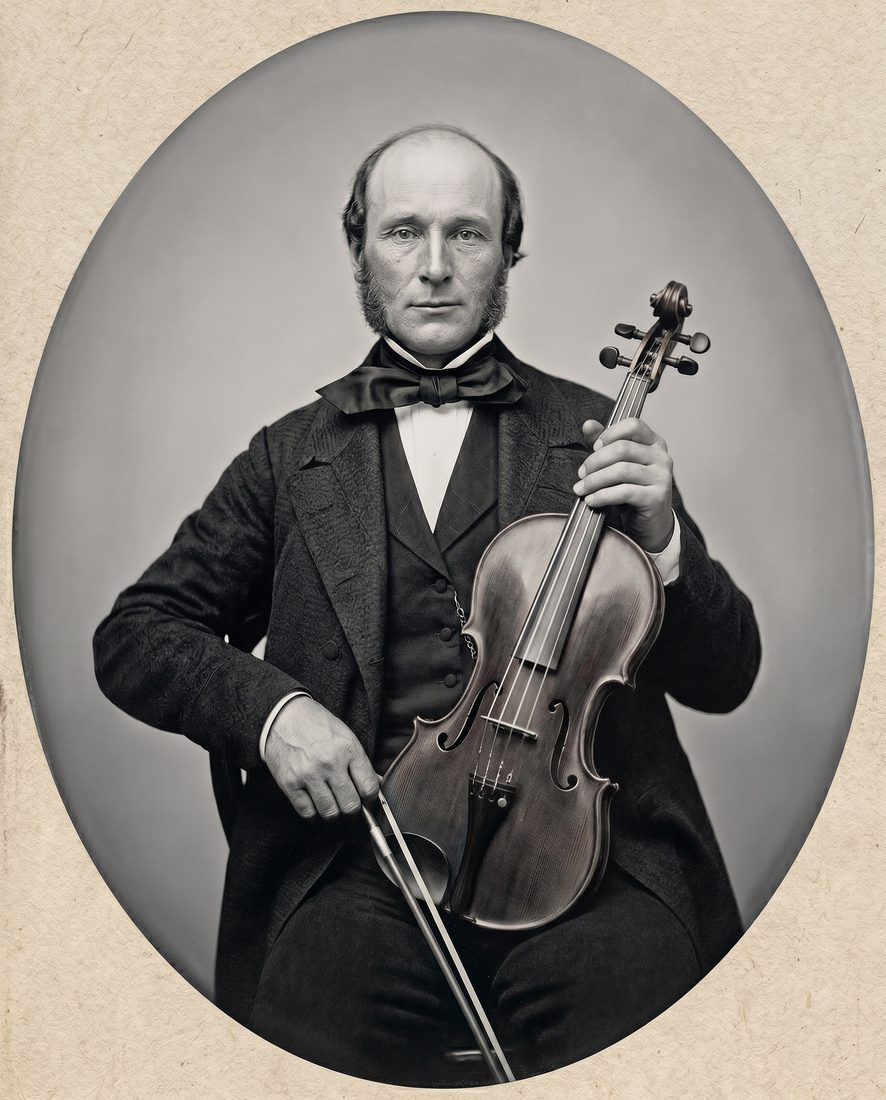
Joel Roger Carter, circa 1860, the father of Sarah, toured with his family band. Originally a photocopy; this image was restored by Gemini AI.
Sarah's older brother Oliver Hare Carter (1843–1931) self-recorded on his own gravestone: Solo player, Grenadier Guards, 1861–1875; Bandmaster, London Irish Rifles Vol., 1875–1899; Bandmaster, 17 Div. Met. Police, 1899–1906; composed 854 hymn tunes.16
Sarah's instrument was the accordion.
Music may have provided some solace to family issues, yet the environment also had its hazards.
In 1979, Fred Davey of Exmouth, a descendant of Sarah's brother J.R. Carter, said he remembers his great grandma saying how Miller Joel stood over his son with a leather belt forcing him to practice his violin for hours.17